Socho ek aisa model jahan aap sirf tab pay karo jab result mile. Yahi hai Pay Per Result Marketing ka concept. Agar tum ek small business owner ho, startup founder ho, ya ek freelancer ho jo apna marketing budget wisely use karna chahta hai. Toh ye guide sirf tumhare liye hai.
Aaj is blog mein hum in sab cheezon ko detail mein cover karenge:
* Pay Per Result Marketing kya hota hai
* Ye kaise kaam karta hai
* types, fayde, aur challenges
* Real examples aur tips
* Kaise tum isse apne business ke liye use kar sakte ho
Toh chalo, seedha point pe aate hain.
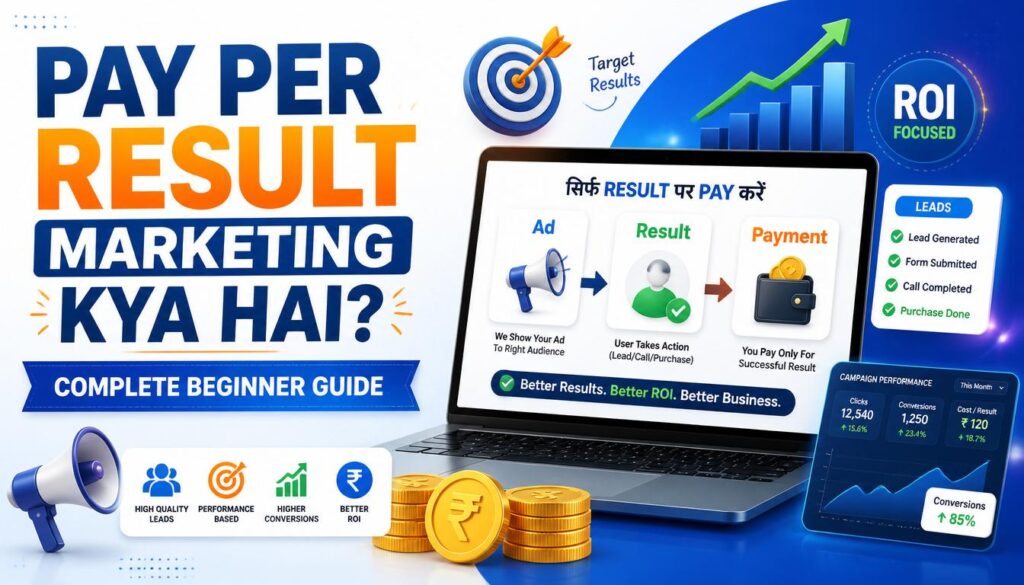
1. Pay Per Result Marketing Kya Hota Hai
Pay Per Result Marketing ek aisa advertising aur marketing model hai jisme advertiser sirf tab paise pay karte ho jab ek specific, pre-defined result achieve ho jata hai. Iska matlab hai. Agar result nahi, toh payment nahi. Traditional marketing mein tum pehle pay karte ho. Chahе result aaye ya na aaye.
2. Pay Per Result Marketing Kaise Kaam Karta Hai
Samajhte hain step-by-step:
* Step 1: Goal Define Karo. Pehle decide karo. Tumhara result kya hoga
* Step 2: Agreement Set Karo. Tum aur tumhara marketing partner ek clear agreement banate ho
* Step 3: Campaign Launch Hoti Hai. Marketing partner apni strategy use karta hai
* Step 4: Results Track Karo. Sab kuch tracking tools se monitor hota hai
* Step 5: Payment Karo. Sirf verified, valid results ke liye payment hoti hai
3. Pay Per Result Marketing Ke Types
Yeh model alag-alag formats mein aata hai. Chaliye dekho:
* A. Pay Per Lead
* B. Pay Per Sale
* C. Pay Per Click
* D. Pay Per Call
* E. Pay Per Install
* F. Pay Per Acquisition
4. Pay Per Result Marketing Ke Fayde
Ab aate hain sab ke part par. Fayde
* Risk Kam Hota Hai
* ROI Clear Hota Hai
* Advertiser Ke Liye Budget-Friendly
* Partner Ko Bhi Performance Ka Incentive Milta Hai
* Data-Driven Decision Making
* Scalable Model Hai
5. Pay Per Result Marketing Ke Challenges
Sab kuch itna nahi hota. Kuch challenges bhi hain jinke baare mein hona zaroori hai:
* Lead Quality Control Mushkil Hoti Hai
* Har Business Ke Liye Fit Nahi Hota
* Upfront Cost Higher Ho Sakti Hai
* Fraud Ka Risk Hota Hai
* Kuch Niches Mein Koi Nahi Karta
6. Pay Per Result Marketing vs Traditional Marketing
Feature. Pay Per Result Marketing. Traditional Marketing
* Payment Timing. Result ke baad. Pehle
* Risk. Marketer pe. Advertiser pe
* Budget Predictability. High. Low
* ROI Clarity. Clear. Unclear
* Scalability. Easy. Difficult
* Lead Quality. Guaranteed nahi
* Best For. SMBs, Startups. Big Brands
7. Pay Per Result Marketing vs Performance Marketing
Bahut log inhe same samajhte hain. Lekin thoda fark hai. Performance Marketing ek broader term hai jisme sab kuch hota hai. Pay Per Result Marketing ek specific subset hai jisme sirf ek -defined outcome par payment hoti hai.
8. Real-World Examples of Pay Per Result Marketing
Example 1: Insurance Agent
Example 2: Local Restaurant
Example 3: E-Commerce Store
Example 4: EdTech Startup
9. Pay Per Result Marketing Kaise Shuru Karein
Agar tum is model ko apne business mein apply karna chahte ho, toh yeh karo:
Step 1: Apna Goal Define Karo
Step 2: Apni Cost Per Result Calculate Karo
Step 3: Sahi Partner Dhundho
Pay Per Result Marketing is a way to get the results you want without wasting money. You only pay when you get the results you want. This way you can control your budget. Get the most out of your marketing efforts. So if you want to try Pay Per Result Marketing follow these steps. Start getting the results you want. Pay Per Result Marketing is an option for small businesses and startups because it is budget-friendly and scalable. Pay Per Result Marketing ke fayde hain risk kam hota hai, ROI hota hai, aur scalable model hai. Pay Per Result Marketing ke challenges hain lead quality control mushkil hoti hai, har business ke liye fit nahi hota, upfront cost ho sakti hai, fraud ka risk hota hai, aur kuch niches mein koi nahi karta. Pay Per Result Marketing vs marketing mein pay per result marketing mein payment timing result ke baad hota hai, risk marketer pe hota hai, budget predictability high hoti hai, ROI clarity clear hoti hai, scalability easy hoti hai lead quality hoti hai, aur best for SMBs startups hota hai. Pay Per Result Marketing vs performance marketing mein pay per result marketing ek specific subset hai jisme sirf ek -defined outcome par payment hoti hai. Pay Per Result Marketing kaise shuru karein yeh steps follow karo: apna goal define karo, apni cost per result calculate karo, sahi partner dhundho. Pay Per Result Marketing is a way to get the results you want without wasting money. Pay Per Result Marketing ke types hain pay per lead pay per sale pay per click pay per call pay per install aur pay per acquisition. Pay Per Result Marketing real-world examples hain insurance agent, restaurant, e-commerce store aur edtech startup. Pay Per Result Marketing kaise kaam karta hai, yeh steps follow karo: goal define karo, agreement set karo, campaign launch hoti hai results track karo, payment karo. Pay Per Result Marketing kya hota hai, yeh ek aisa advertising aur marketing model hai jisme advertiser sirf tab paise pay karte ho jab ek specific, pre-defined result achieve ho jata hai. Pay Per Result Marketing is a way to get the results you want without wasting money. Pay Per Result Marketing ke fayde hain risk kam hota hai, ROI hota hai, aur scalable model hai. Pay Per Result Marketing ke challenges hain lead quality control mushkil hoti hai, har business ke liye fit nahi hota, upfront cost ho sakti hai, fraud ka risk hota hai, aur kuch niches mein koi nahi karta. Pay Per Result Marketing vs marketing mein pay per result marketing mein payment timing result ke baad hota hai, risk marketer pe hota hai, budget predictability high hoti hai, ROI clarity clear hoti hai, scalability easy hoti hai lead quality hoti hai, aur best, for SMBs startups hota hai.
Here is the rewritten text in a human- writing style:
Lets talk about affiliate networks. We have ShareASale, CJ Affiliate and Impact. Then there are agencies that do performance-based work. We also have freelance marketers and influencers who work on an commission model.
Now lets move on to the steps to make this work.
Step 4 is to create a contract. This is very important. In the contract we need to define what a lead or result means to us. We also need to specify the quality parameters, payment schedule and clauses to prevent fraud.. We need to decide how often we will report on the progress.
Step 5 is to set up tracking. Without tracking we cannot measure the success of our campaign. We can use tools like Google Analytics to track website visits and conversions. We can use Facebook Pixel to track ad conversions. We can use UTM parameters to track the source of our leads. We can use CRM software to manage our leads.. We can use call tracking tools for businesses that rely on phone calls.
Step 6 is to monitor, optimize and scale our campaign. We need to look at the data every week and see what is working and what is not. We need to scale up what is working and stop what is not. Continuous optimization is the key to making this model work.
Now lets talk about the tools for pay per result marketing. We have Google Analytics, Google Tag Manager, HubSpot CRM, ClickMagick, Voluum Facebook Pixel, CallRail and Tapfiliate. Each of these tools has its unique features and pricing.
So, which businesses are best suited for pay per result marketing? Ideal businesses include insurance agencies, real estate, education and coaching, e-commerce, local services and SaaS companies. These businesses have goals and can track their results easily.
On the hand some businesses may find it difficult to implement pay per result marketing. These include niche B2B companies, businesses that sell high-ticket items with long sales cycles businesses without any tracking setup and companies with unclear value propositions.
Now lets talk about the relationship between affiliate marketing and pay per result marketing. Affiliate marketing is a form of pay per result marketing specifically the pay per sale model. When we promote a product on our blog, YouTube or Instagram and earn a commission for each sale that is pay per result marketing in action.
In India popular affiliate programs include Amazon Associates, Flipkart Affiliate, HostGator, Bluehost, Upstox, Zerodha, Coursera and Udemy. If you are a content creator or blogger affiliate marketing can be a way to earn income.. If you are a business owner it can be a cost-effective marketing channel.
Now lets talk about mistakes to avoid in pay per result marketing. Mistake number one is not defining the result clearly. If we are not clear about what a lead means to us we will have confusion with our partners. Mistake number two is starting a campaign without setting up tracking. We cannot prove the result without tracking. Mistake number three is not defining quality standards. We need to specify what kind of leads we want otherwise we will get leads. Mistake number four is relying on one partner. We need to diversify our partners and channels to reduce risk. Mistake number five is not thinking term. Pay per result marketing is not a short-term fix it is a long-term strategy.
Finally lets talk about the future of pay per result marketing in India. The digital marketing industry is growing rapidly in India and after COVID businesses are shifting online. Small and medium businesses are losing confidence in ads and shifting to performance-based models. Some trends that will become popular in the future include AI-powered lead scoring, WhatsApp-based lead capture, vernacular content marketing, hyperlocal campaigns and video-first affiliate marketing.
In conclusion pay per result marketing is a way to ensure that we only pay for results. It gives us accountability, clarity. Saves us from wasting our budget. Whether you are a shop owner, an insurance agent, a content creator or a growing startup this model can work for you. Just remember to set goals set up tracking choose the right partners and monitor your results. If you need help setting up a pay, per result marketing strategy or any other digital marketing help just comment below. Contact us. We can create a custom plan for you.